Confidential:
Open Access court case: urgent appeal for expert testimony on point clouds
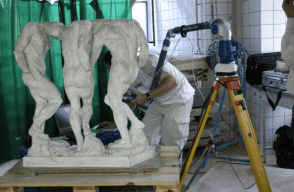
I’m an open access activist, and am five years into litigation in Paris against the Rodin Museum, which is an arm of the French government and the extremely influential Ministry of Culture. My lawsuit seeks to establish, by means of French freedom of information law, the public’s right to access 3D digitizations of public domain cultural heritage works held by French national museums.
My co-plaintiffs are Wikimédia France, French digital rights advocacy organization La Quadrature du Net, and the Brussels-based organization Communia, which works with cultural heritage institutions and policy makers throughout Europe advocating for expansion of and access to the public domain. We’re represented pro bono by Wikimédia France’s attorney, Alexis Fitzjean Ó Cobhthaigh. Links to news coverage of our case are at the bottom of this page.
For strategic reasons we have not yet publicized this, but earlier this year the Administrative Tribunal of Paris issued its ruling, and it was mixed.
We won important, significant victories on every point of law and principle, establishing for the first time the public’s right to access the government’s 3D scans of works in the public domain. The court ordered the museum to make several of its 3D scan files public. (Though the museum has not complied, now many months past the court’s deadline.)
But the court also carved out a very strange and problematic exception specifically for files containing point clouds in general, and raw data from point clouds. The court’s reasoning is based on technical misunderstandings of point clouds and file formats, and misleading characterizations of points clouds by a sole, anonymous IT technician.
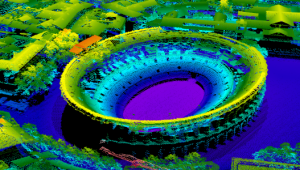
The Paris court’s point cloud exception, if left standing, jeopardizes public access to point cloud documents produced by French public agencies, regardless of their subject and origin. That would include not only cultural heritage works, but environmental and infrastructure surveys and surveillance, among many other subjects, including, for example, the kind of data produced by this ongoing government LiDAR project to 3D scan the entire territory of France: https://geoservices.ign.fr/lidarhd (Paris example here: https://demo-lidar.ign.fr/ )
The court’s decision on point clouds is a very serious threat to the public’s right to access invaluable data and documents, whether they are sought by researchers, educators, students, entrepreneurs, artists, art lovers, or anyone else.
How you can help
We have initiated an appeal in the Conseil d’Etat, the French supreme court for administrative justice, and we urgently need your help.
Two years ago Professor Michael Kazhdan of Johns Hopkins University, co-developer of the Poisson Surface Reconstruction algorithm, provided us with a short technical advisory letter addressed to the Paris court, about the nature, utility, and value of point clouds and raw data from 3D data acquisition. We submitted Professor Kazhdan’s letter to the court as evidence and quoted it in our filings, and it is now an extremely important piece of evidence in our presentation to the supreme court.
Professor Kazhdan will be writing another letter for us, now for the supreme court, to elaborate on the lower court’s persistent technical misunderstandings of point clouds. We need to supplement his voice with letters from additional leaders in the field of 3D data acquisition, handling, cultural heritage preservation, software developers, end users, and anyone with expertise in point clouds and an interest in protecting the accessibility of this important data.
Will you please contribute a letter?
A letter from you—either in your personal capacity or on behalf of your organization—would make a big impact in our effort.
A short letter would be great. Or if you want to expand on several of the points listed below that we need to address, a few pages more would be good too. Frankly, whatever you have time for since time is short.
For your consideration, I’ve outlined below the specific points we need letters to address, and their presentation. We certainly don’t need each letter to address every point, but if we get enough experts like you commenting on the ones they feel strongly about, it will make a big impact in court.
We realize this is asking a lot on very short notice, but ideally, we would like to have all letters in hand and finalized by the end of the day, Friday November 17.
Please let me know if you’d like to discuss any aspect of this at your convenience, and thank you for your consideration.
Sincerely,
Cosmo Wenman
310-780-5130 (I am in San Diego, California)
cosmo.wenman@gmail.com
https://cosmowenman.com/point-clouds/
Objective of your letter
The museum admits to having point cloud files of several sculptures, but it refuses to say how many it has, and which works it scanned. (We have reason to believe that it scanned many, many important works, and all in very high quality.) Instead, the museum tried to convince the lower court that point cloud documents are by their nature fundamentally “incomplete” and have no utility, and even suggested that the fact that the files are in open, text formats means they are incomplete “raw data” that can’t be used without complex post-processing by experts (processing which it never identified).
The museum argued that this supposed incompleteness of point cloud documents means they do not need to be made public. Its reasoning was confused and inconsistent, and contrary to industry practices; it was a nonsensical smokescreen to avoid publication. But the lower court deferred to the museum on this specific ploy.
We need to submit letters to the supreme court that dispute the Paris court’s determination that documents containing point clouds are by their nature “incomplete” or merely intermediate documents. We need to dispute the court’s determination that scan documents containing supposedly “raw data” are fundamentally “incomplete” and not useful to the public.
We need to affirm point clouds’ and raw data’s value and utility to the public.
Your letter: introducing yourself
It is important to identify yourself and establish your expertise at the beginning of your letter. Please include any relevant affiliations, degrees, awards, papers, publications, patents, profession, employer, the importance of your work, notable/interesting relevant projects you have worked on or are currently working on—anything that will establish that you know your stuff. Please do brag, it’s actually important here.
Please see Professor Kazhdan’s original letter to the lower court for an example of how we presented him and his argument: Expertise technique du professeur Kazhdan.pdf (Note: Several of his previous observations about the utility and desirability of point clouds are still very relevant for our new letters.)
For reference, this is how we’re introducing Professor Kazhdan now to the higher court, in the body of our new filing:
In order to provide useful information to the court, the exhibitor had called upon the expertise of Professor Michael Kazhdan, full professor of computer graphics in the department of computer science at Johns Hopkins University. Professor Kazhdan serves on the programming committee of the Special Interest Group on Computer Graphics and Interactive Techniques (SIGGRAPH) conference of the Association for Computing Machinery, and is an associate editor of the journal Transactions on Graphics. He has a research impact of 36 on the h-index. His research papers in the field have a value of 63 on the i-10 index and have been cited more than 17,000 times. Further, he co-developed the Poisson Surface Reconstruction algorithm which constitutes a standard analysis tool for the reconstruction of geometric surfaces from raw data from 3D scans, which is used around the world in countless applications, relating in particular to scans of cultural heritage, and medical scans of the human body, and the surface of the planet Mars based on data collected by the robot Curiosity.
And our colleague, cultural heritage 3D scanning expert Ghislain Moret de Rocheprise:
The exhibitor had also called on the technical expertise of Mr. Ghislain Moret de Rocheprise, former director of the 3D Scan department of the company Dynamic 3D (from 2006 to 2010), and founder and director of the Lithias workshop from 2010 to 2019 (stone sculpture workshop developing mixed creation techniques between 3D scanning, robotic machining, and classical sculpture.)
Ghislain’s original letter to the lower court (in French) made very effective use of images to illustrate his points: Expertise technique de M. Ghislain Moret de Rocheprisee.pdf
Your expert opinion
In your commentary, technical terminology is fine, but the reasoning should be accessible for a smart layperson reader. We may suggest edits to your letter for clarity or emphasis, or for brevity.
Disputing assertions made by the government and lower court that we need to counter:
Concise explanations and specific examples illustrating how these claims are wrong would be very helpful:
- In general, the museum asserted that point clouds and raw data from scans are not useful to the public, as they are only intermediate steps in the production of subsequent visualizations and other treatments (such as converting them to STL files for mesh-based uses.)
- The public doesn’t need or shouldn’t have access to point clouds and raw scan data because they are merely the raw material needed for the production of subsequent documents.
- Because point cloud files and point cloud raw data supposedly function only as intermediate steps, they should not be considered in themselves “completed” documents.
- Because they are supposedly incomplete or not useable in themselves, files consisting of points clouds and raw data from 3D scanning, do not in and of themselves accomplish any intent for producing the scan.
- Point clouds and point cloud raw data files in text format (ASCII, TXT, possibly also OBJ and others: we’re not sure exactly what specific formats they have) cannot be used without significant post-processing by specialists who are equipped with specialized software.
- Point clouds and raw data files in text format require significant post-processing by specialists equipped with specialized software in order to make any visualization of the data.
- Point clouds and raw data files in text format are unusable because the museum’s anonymous technical service provider couldn’t figure out how to use them. (Yes, they actually made this argument.)
The lower court already rightly shot down the following three arguments put forward by the museum, but they were such strange claims that I want you to be aware of the context of the museum’s other unusual assertions and how damaging the museum’s positions would be from a cultural heritage preservation/archival perspective if they were implemented more broadly:
– Point clouds that contain “gaps” in the scanned surfaces (such as gaps that commonly result in scans from occluded features or scan equipment inaccessibility) render the point cloud document itself “incomplete”. (As if a photograph that did not capture an occluded surface were an “incomplete” photograph.)
– Such “gaps” render point clouds unusable and worthless to the public.
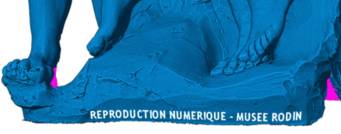
– Point clouds and raw data scan files of artwork and cultural heritage subjects are “incomplete” if it have not been subsequently edited to digitally inscribe a visible and indelible “Reproduction” watermark directly onto the surface geometry of the resulting digital model. (They actually did this to two STL files we forced them to produce during trial.)
Affirmations and examples that we need to offer:
Specific examples, principles, best practices (and images, screengrabs, photos) illustrating the following would be great:
- Files consisting of points clouds and point cloud raw data from 3D scans are trivially easy to visualize with many different software and web-based visualization tools and services, including many that are free and open source. (CloudCompare, MeshLab, Potree, Sketchfab, ReCap etc.) Please emphasize this if you have been involved in making such tools or use them regularly or publish scans with them.
- It is desirable and a common best practice across the industry to keep point clouds and point cloud raw data in open formats because, etc.…
- Raw data in text format is an ideal format for documenting scanning measurements because it is a common format, open, and easily convertible to other formats for specialized and unforeseen end-uses.
- It is a misconception that raw scan data is not useful to the public.
- For research and archival purposes, the original point cloud data and raw data is essential, and the most valuable and durable, and future-proof type of data and format.
- It is important for the public to have access to the unprocessed, unedited data, so that they do not inherit poor, inappropriate, or outdated practices from prior processing.
- For archival purposes, it is essential to have access to the original point cloud as a record of the subject at the time of the scan, and to have it as a record of how the scan itself was actually performed.
Non-technical commentary:
At the end of the letter, please add any additional relevant commentary you think would be helpful or feel strongly about. Please be concise. Examples:
- What are some important kinds of public data sets that you would not want to be put at risk of being inaccessible?
- Why do you want to access public point cloud data? What worthwhile thing would you do with it, or currently do with it?
- Who is your audience for what you produce with point cloud data, and why are they important? Why is important for you to provide them with public point cloud data?
- Risks, bad outcomes of no access
- Why do you want the public to be able to access it themselves?
- Why do you think access to point clouds and raw scan point cloud data is important for cultural heritage preservation and appreciation, as well as for commercial development? Examples.
- What are you working on that would be jeopardized if you could not access it?
- Researchers, entrepreneurs, and artists are likely to be better informed on the technology and its uses, usability, value, and potential than any given museum administrator or technician may be.
- As a matter of public accountability, it is important to be able to access unprocessed scan data in order to evaluate how an administrative agency is monitoring, maintaining, and documenting the scan subjects in its care, without their altering the data beforehand, whether the subject is artwork, the environment, or civil infrastructure.
- The ultimate goal of scanning cultural heritage works is, ideally and typically, to disseminate those scans and the original, most valuable and useful data to researchers, preservationists, historians, teachers, students, artists, art lovers; that is, to as many people as possible: to everyone. (In fact, FYI, when the Rodin museum asked the government for funds to 3D scan its collection, it very clearly stated their intent to disseminate the results to the public for all the typical good, public-spirited reasons, and dissemination was the express purpose of the Ministry funding.)
- Examples of relevant important institutions’ policies, and government agency policies (but not laws), and best practices and statements of principles that incorporate and reflect the good stuff above.
- Specific real-world examples of any or all of the above!
Please avoid:
Please avoid legal analysis or references to court cases or laws. Commenting about open data, open government and open access principles would be great, but we need to avoid raising new legal arguments that have not already been litigated in the case thus far. (Though feel free to send your observations to us, separate from your letter.)
We don’t need deep dives on specific tech or terminology or detailed processes. In part because we don’t want to introduce any specific technical terms we haven’t already introduced or that might invite the government to try to split hairs over. Generalized examples and analogies would be great though.
Format
If you are fluent in French, please write your letter in French, otherwise please write in English. We will submit your final English version to the court as the authoritative version, along with a separate document with French translation for the court.
Please send a document in Word .docx format, on your preferred letterhead, or institutional letterhead if appropriate.
Images in the body of your letter would be excellent. Please keep an eye on total file size.
Please sign your letter. (It needs to be signed to be admissible.)
Coordinating
If you’ve been referred by Andrew H, he’s volunteered to organize any drafts you may send; please coordinate directly with him.
If you’ve been referred by Ghislain, please send your original drafts in French to him.
Otherwise, please send your draft to me at cosmo.wenman@gmail.com
Whomever referred you, please contact me if you’d like me to clarify any aspect of this project or request.
Thank you very much for your help.
– Cosmo
310-780-5130 (I am in San Diego, California)
cosmo.wenman@gmail.com
—
Select media coverage of the case
The Art Newspaper
“Musée Rodin could be forced to release 3D scans of bronze sculptures—including The Thinker—to the public”
English: https://www.theartnewspaper.com/2021/03/05/musee-rodin-could-be-forced-to-release-3d-scans-of-bronze-sculpturesincluding-the-thinkerto-the-public
French: https://www.artnewspaper.fr/2021/03/22/le-musee-rodin-menace-de-devoir-rendre-publics-les-scans-des-ses-sculptures
Communia announcement
“The public domain belongs to all and is often defended by no-one: we want to change that”
https://communia-association.org/2021/05/31/the-public-domain-belongs-to-all-and-is-often-defended-by-no-one-we-want-to-change-that/
NextINpact
“Le scan 3D du Penseur de Rodin est un document administratif communicable”
French: https://www.nextinpact.com/article/29490/107996-le-scan-3d-penseur-rodin-est-document-administratif-communicable
“The scan of Rodin’s Thinker is a communicable administrative document”
(English PDF)
Independent legal analysis/overview
“A museum has been ordered to communicate 3D scans of works of art that have fallen into the public domain”
Original French: https://feral.law/publications/un-musee-condamne-a-communiquer-les-numerisations-3d-doeuvres-dart-tombees-dans-le-domaine-public/
English: https://feral-law.translate.goog/publications/un-musee-condamne-a-communiquer-les-numerisations-3d-doeuvres-dart-tombees-dans-le-domaine-public/?_x_tr_sl=fr&_x_tr_tl=en&_x_tr_hl=en&_x_tr_pto=wapp
 COSMO WENMAN